
Here’s the honest answer first: yes, you can land a work-from-home job with no experience. But let’s set expectations right — the real ones aren’t glamorous. We’re talking customer support, data entry, scheduling, virtual assistance. Entry-level pay, sure, but they really do hire people with no track record — and if you play it smart, the first one becomes a launchpad to something better. Below are ten options that actually exist, what the day-to-day really looks like, and how to get your foot in the door with a blank resume.
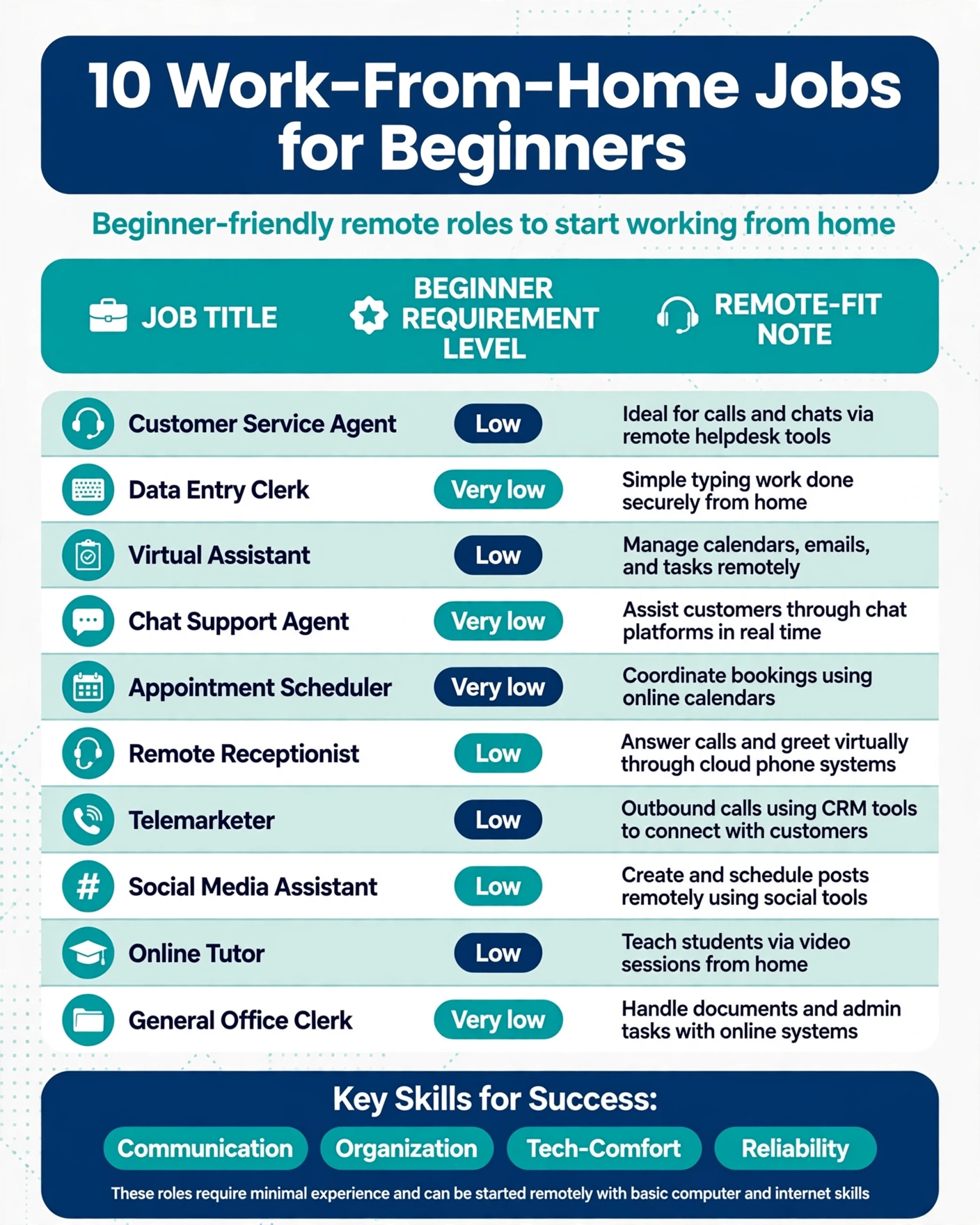
In this guide: What “no experience” really means · The 10 jobs · Quick comparison · How to land your first remote job · Where to find legit openings · 5 scam red flags · Resume tips · FAQs
What “No Experience” Actually Means in Remote Hiring
Quick reality check: “no experience required” never means “no skills required.” It just means nobody’s asking for previous job titles in the same field. What they are checking is simpler — and harder to fake. Can you type without looking at the keyboard? Write an email that makes sense? Show up on time for a shift nobody’s watching? Learn a new tool without freezing up?
Remote work has a catch, though: it actually raises the bar on this stuff. Your manager can’t see you working, so reliability and clear writing matter more from home than they do in an office. The good news? Every bit of it is learnable, and none of it needs a degree. The Bureau of Labor Statistics backs this up — the biggest beginner-friendly occupations typically ask for nothing more than a high school diploma and a few weeks of on-the-job training.
One more thing worth knowing: “remote” means different things at different companies. Some are fully remote, some are hybrid, some just let you work from home two days a week. Read the actual posting — don’t assume.
10 Work-From-Home Jobs That Hire Beginners
1. Customer Service Representative
This is the classic entry point, and there’s a reason for that. You’d be answering customer questions by phone, chat, or email — resetting passwords, tracking down orders, fixing billing mistakes, talking down the occasional frustrated caller. The work repeats itself, and it can get monotonous. But companies are always hiring for this, training is usually paid, and they’re screening for patience and communication skills — not credentials.
Money-wise, the BLS puts the median at $44,770 a year (about $21.53 an hour) as of May 2025. One honest caveat: the field is expected to shrink about 5% through 2035 as routine tasks get automated. Sounds bad — but roughly 289,500 openings a year are still expected just from people changing jobs or retiring. There’s plenty of room.
Where do beginners actually get hired? The big contact-center companies — TTEC, Concentrix, Teleperformance (now calling itself TP), Foundever, and Sutherland — hire remote support agents in batches, provide paid training, and regularly post roles that ask for a high school diploma and little or no experience; check their careers pages directly. (For the record: every company and platform named in this guide was checked against its own official site when the guide was updated — and where a famous name turned out not to fit beginners, the guide says so plainly instead of recommending it.) Software firms, retailers, and telecom companies also build in-house support teams. And CareerOneStop’s job finder is a solid starting point too.
2. Data Entry Clerk
Quiet work — literally. You type information into systems all day — order details, survey responses, inventory counts. Nobody’s calling you, nobody’s watching over your shoulder. Accuracy matters more than speed here (speed comes later, once your fingers know the drill). There’s no credential for this; employers will just test your typing and move on.
On pay, honestly: rates vary so wildly that there’s no trustworthy national figure — BLS doesn’t even publish a standalone median for this occupation, so anyone quoting you one is guessing. Expect entry-level hourly.
Staffing agencies and company career pages are where these postings live. Two verified starting points beyond the job boards: Rev takes on freelance transcriptionists — data entry’s close cousin — through a short skills assessment and a sample piece, no resume needed (paid per audio minute, weekly; there’s currently a waitlist, which tells you how many beginners apply). And micro-task platforms like Clickworker hand out small data, research, and AI-training tasks with a free sign-up — small tasks, small pay, but a real first rung. And a heads-up: this category attracts a lot of scammers. Read the red flags section below before you apply anywhere.
3. Virtual Assistant
Think of it as being someone’s remote right hand. One day you’re managing a founder’s calendar, the next you’re booking travel, untangling an inbox with 3,000 unread emails, or pulling together a spreadsheet. Every client needs something slightly different, which keeps it interesting — and means clients hire based on how organized you actually are, not what’s on your resume. If you’re the friend everyone asks to plan the trip, you’ve already got the core skill. Google Workspace or Microsoft Office fluency does the rest. No degree needed, no certificate either.
Most beginners start with small part-time contracts, usually hourly. Freelance platforms, VA agencies, and small-business job boards are the hunting grounds. One genuinely beginner-friendly name: Fancy Hands, which takes on assistants for small tasks — calls, research, scheduling — and asks for a fast internet connection and basic web skills rather than a resume. (Bigger VA agencies like BELAY usually want prior admin experience, so treat those as a step-two target, not a first application.) And a pro tip: ask for a paid trial task before committing to anything long-term. Serious clients will say yes. For a deeper look at this path, see our virtual assistant jobs guide.
4. Chat Support Agent
Same universe as customer service, minus the headset. Instead of calls, you’re juggling two or three chat windows at once, pulling answers from a knowledge base, and solving problems in writing. If you’ve ever thought “I’m better in text than on the phone” — this is your lane.
Pay-wise it falls under the customer service umbrella, so figure around that same BLS median of $44,770 a year, though individual chat roles bounce around. The same verified contact-center employers from the customer service section — TTEC, Concentrix, TP, Foundever, Sutherland — run chat programs too, alongside e-commerce and software firms with online support teams. The best-known chat-and-community specialist, ModSquad, is upfront that it accepts only experienced support professionals — treat it as a step-two target once you have some months in.
5. Appointment Scheduler
Dental offices, law firms, clinics, repair companies — they all run on appointments, and someone has to keep that machine oiled. That someone could be you, working from home: booking, confirming, reshuffling when patients cancel, sending reminders. You’d live inside a scheduling system all day. What matters here isn’t a credential — it’s a friendly phone manner and the kind of attention to detail where double-bookings just don’t happen to you.
Pay depends a lot on the industry; healthcare and legal schedulers tend to do better than average. A useful search trick: in healthcare, this same job is often posted under the title medical secretary — and BLS puts medical secretaries at a $45,930 median (May 2025), with employment projected to grow as the healthcare industry expands. (The closest general reference point is receptionists at $38,010.) Check healthcare practice websites, service-company career pages, and staffing firms — and if the healthcare angle appeals to you, our guide to hospital jobs with no experience is worth a read.
6. Remote Receptionist
You’re the voice of the business, just from your living room instead of a front desk. Calls come through a cloud phone system, you answer, take messages, route people to the right person — sometimes with light scheduling or intake forms on top. Employers will train you on their system; what they’re really listening for is a clear speaking voice and someone who stays calm when three lines ring at once.
The BLS median for receptionists is $38,010 a year (2025), with about 128,500 openings expected yearly from turnover even though overall growth is flat. Virtual receptionist service companies are the sweet spot for beginners. Two names worth knowing: Ruby and Smith.ai both hire receptionists as regular employees (not contractors), train you before you take live calls, and treat customer-service experience as a plus rather than a requirement — Ruby asks for typing around 40 WPM, and Smith.ai describes its starting wage as an entry-level rate.
7. Telemarketer / Entry-Level Sales Representative
Fair warning: this one’s not for everyone. You’d be contacting potential customers by phone or email, following a script at first, logging everything in a CRM — and hearing “no” a lot. But here’s the flip side nobody mentions: entry-level sales roles usually come with genuine training, and the persuasion skills you build transfer to almost any career you touch afterward.
O*NET OnLine — the U.S. Department of Labor’s occupational database, a separate dataset from BLS — puts the median at $35,450 a year, roughly $17.04 an hour, and the occupation is projected to keep declining — so be picky. Favor roles offering base hourly pay over pure commission, and always confirm the pay structure before you accept anything.
8. Social Media Assistant
Small business owners all know they should be posting regularly. Almost none of them have time. That’s the gap you’d fill: drafting captions, scheduling posts, replying to routine comments, maybe putting together simple graphics. No marketing degree required — but you do need to genuinely live on social media and understand what makes someone stop scrolling. Here’s the nice part: a personal account you’ve grown yourself absolutely counts as proof. That’s your portfolio.
Pay is usually hourly or per-project and varies a lot. Look on small-business job boards and freelance platforms — or just reach out directly to local businesses whose accounts have been dead for six months. They know it’s a problem. One reality check from the biggest marketplace: on Upwork’s social-media board, most postings ask for intermediate or expert level — which is exactly why the direct-outreach route often beats the marketplaces for a true beginner.
9. Online Tutor
Good at math? English? Science? There are parents out there who’d happily pay a patient person to walk their kid through it over video, 30 to 60 minutes at a time. Requirements genuinely vary — some platforms will test your subject knowledge, others mostly care that you can explain things without losing your patience. A teaching certificate is rarely required; real subject knowledge matters more.
It’s typically hourly per session, varying by subject and platform. Tutoring platforms and local parent networks are where the work is. On Wyzant, new tutors create a profile, pass a subject check, and set their own rate — no sign-up fee, though the platform keeps 25% of what students pay. Read each platform’s requirements carefully, though: some big names are stricter than they look — Tutor.com’s main tutoring roles require a 4-year degree. And a two-minute video of yourself explaining a concept clearly works wonders as a portfolio piece. It shows exactly what they’d be buying.
10. General Office Clerk (Remote)
The remote version of classic office support: typing up documents, filing digital records, answering phones, handling routine correspondence. The typical path in is a high school diploma plus a few weeks of on-the-job training — that’s it.
And here’s a number worth knowing: the BLS median is $45,010 a year (2025) — the highest direct figure for any of the ten roles themselves. (One neighbouring occupation edges past it: medical secretaries, at $45,930 — see the scheduler section.) You may have to dig a little more for fully remote postings than with support roles, but they’re out there — company career pages, contractors, and occasionally federal listings on USAJOBS marked remote-eligible. Per BLS, the biggest office-clerk employers are schools, healthcare, and government — and all three hire through their own job boards, so check those directly too.
Quick Comparison
| Job | Entry barrier | BLS-verified pay | Remote fit |
|---|---|---|---|
| Customer Service Rep | Low | $44,770/yr | Excellent — the classic remote beginner job |
| Data Entry Clerk | Very low | Varies (no BLS figure) | Good — lots of scam postings in this category; verify employers |
| Virtual Assistant | Low | Varies | Excellent — remote by definition |
| Chat Support Agent | Very low | ~$44,770/yr (as customer service) | Excellent — text-only suits home offices |
| Appointment Scheduler | Very low | Varies (medical secretaries: $45,930; receptionists: $38,010) | Good — common in healthcare/services |
| Remote Receptionist | Low | $38,010/yr | Good — via cloud phone systems |
| Telemarketer / Sales Rep | Low | $35,450/yr (O*NET) | Good — check base pay vs. commission |
| Social Media Assistant | Low | Varies | Good — portfolio beats credentials |
| Online Tutor | Low–Moderate | Varies | Excellent — video sessions from home; expect a subject test, and some platforms require a degree |
| General Office Clerk | Very low | $45,010/yr | Moderate — fewer fully remote postings |
How to read the pay figures: every number above comes from BLS or O*NET (linked where it first appears). These are medians across all experience levels — a beginner usually starts below the median and works up to it. Two of them are labelled proxies, on purpose: chat support has no BLS category of its own, so it uses the customer service figure; appointment scheduling has none either, so it borrows two neighbours — receptionists for general roles, medical secretaries for healthcare ones. Where a job says “varies,” no official figure exists — sites quoting one are guessing, and we’d rather tell you that than invent a number.
How to Land Your First Remote Job With No Experience
Alright, so “no experience required” doesn’t mean “no competition” — plenty of other beginners are applying for the same postings. Here’s how you actually stand out:
Pick one lane — and stay in it for two weeks. Phone person? Text person? Organizer? Choose the role that fits how you naturally work and focus your energy there instead of spraying applications everywhere.
Build one tiny proof of skill. No work history? Make some. Type up a sample data set, neatly. Write three sample captions for a real local business. Record a two-minute video explaining a math concept. Attach it to your application. A hiring manager will remember the applicant who showed something over fifty who just claimed it.
Learn the tools before the interview. If a posting mentions a scheduling app or support platform, spend an hour with its free version or tutorial videos beforehand. Saying “oh yeah, I’ve already used something like this” in an interview carries real weight.
Apply where beginners actually get hired in batches. Company career pages, virtual receptionist services, tutoring platforms, staffing agencies — these places onboard groups of beginners at a time, which means they’re set up for people like you.
Treat the application like the job itself. Applying for customer service with typos in your cover letter? That tells the hiring manager everything. Write carefully, follow every single instruction in the posting, answer emails promptly. You’re demonstrating the skills while you apply — whether you realize it or not.
Where to Find Legitimate Remote Openings in the USA
A few places worth your time — all real, and free to look through:
- CareerOneStop — run by the U.S. Department of Labor, with a profile for nearly every role on this list.
- USAJOBS — federal jobs only, but remote eligibility is clearly marked on each posting.
- Company career pages — software firms, telecoms, e-commerce companies, and virtual receptionist services post beginner remote roles directly, and these tend to be the most legitimate listings you’ll find.
- Staffing agencies — several large agencies run dedicated remote-support pipelines and place beginners every single week.
- Contractor platforms (LiveOps, Working Solutions, Arise) — these connect home-based agents with big brands’ support programs, and beginners do get in. But understand the model before the scam section below confuses you: here you are NOT an employee — you’re an independent contractor, basically a one-person business. No benefits, your own computer and headset, flexible hours as the trade-off. Fees differ by platform and are published upfront: Working Solutions charges nothing (its certification is free), LiveOps charges a $25 background-check fee, and Arise charges a platform fee ($19.75 twice a month, only once you’re actively servicing) plus a refundable deposit before its certification course. That’s a different pattern from the scam in the red flags below — a fake “employer” inventing charges to hire you. Still: read any platform’s fee page before you pay a cent.
One caution that applies everywhere: a platform listing never guarantees a vacancy is legitimate. Verify the employer before you hand over personal information. Which brings us to…
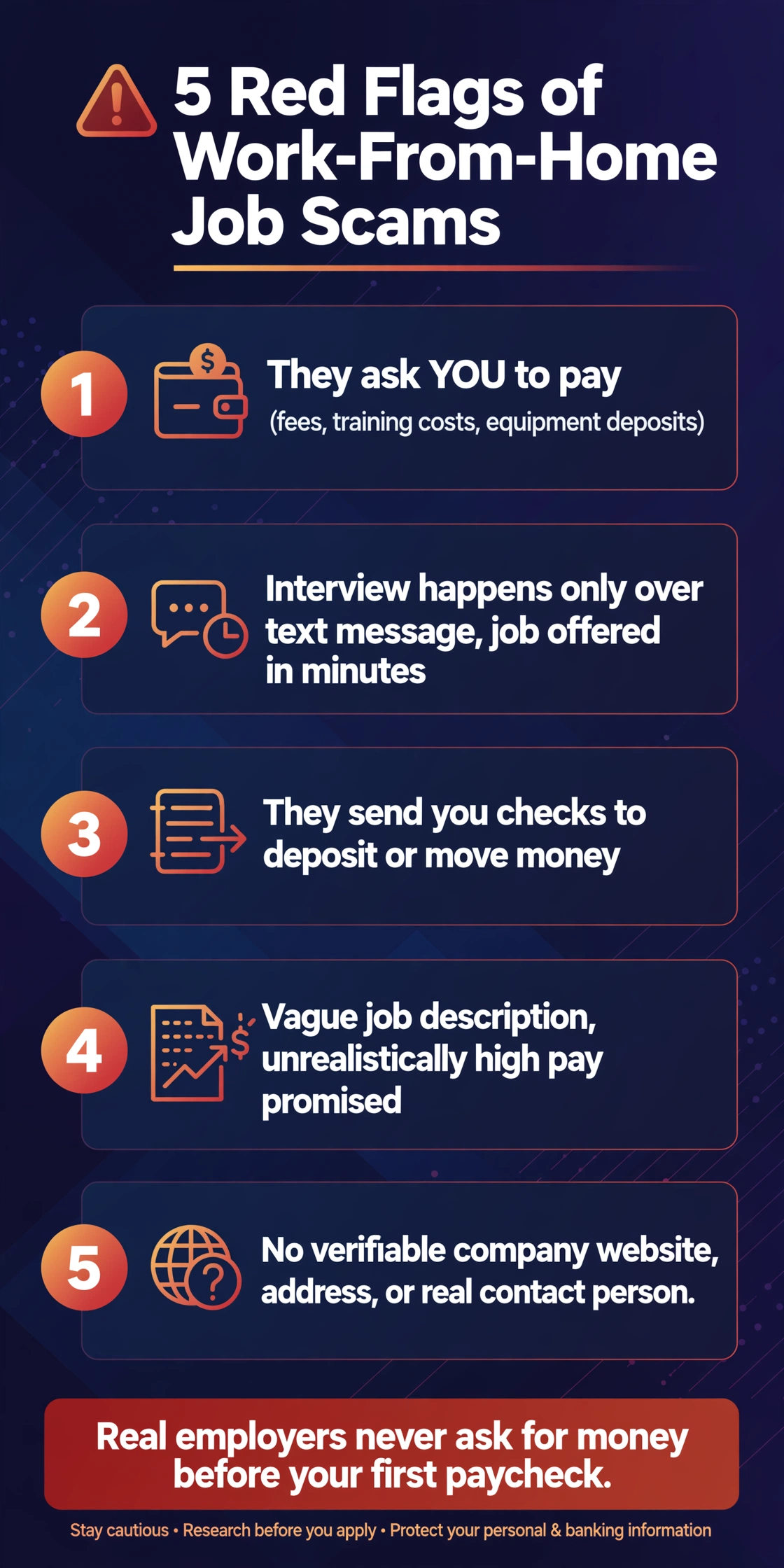
5 Red Flags of Work-From-Home Job Scams
The Federal Trade Commission doesn’t mince words on this: an honest employer will never ask you to pay to get a job. Keep these five in your back pocket:
- A supposed employer asks you to pay to get hired — for “training,” starter kits, equipment deposits, or a background check as a condition of a job offer. Per the FTC, a real employer never does this; walk away. (Not the same thing: the contractor platforms above, where you’re self-employed and any fees are published on the platform’s own fee page before you join. A fee that first appears mid-“interview,” over chat, is the scam pattern — whoever is asking.)
- The whole “interview” happens over text, WhatsApp, or Telegram. Fake recruiters now run entire hiring processes inside messaging apps. Treat a text-only interview as a warning sign — especially when the “recruiter” can’t be verified anywhere outside that chat.
- They send you a check and ask you to forward money somewhere. The classic fake-check scam — the check bounces days later, and the bank comes after you, not them.
- You’re “hired” within minutes, no real interview. Instant offers feel flattering. They’re bait. Real hiring takes a little time — that’s normal.
- The pay sounds absurd for the task. Thousands a month for a few hours of easy work a week? That’s exactly how the FTC says these scams are pitched.
Before you accept anything: google the company name plus the word “scam,” describe the offer to someone you trust, and never — ever — deposit checks on an employer’s behalf. More at ftc.gov/jobscams; report anything fishy at ReportFraud.ftc.gov.
Resume Tips When You Have No Work History
Blank resume? Don’t panic — just reframe what you’ve already done:
- Lead with checkable skills. Typing speed (with WPM if you’ve tested it), software you know, languages you speak — stuff an employer can verify. Our resume skills guide shows the format that actually gets responses.
- Translate life into experience. Ran a household? That’s scheduling and budgeting. Helped at a family shop? Customer service. Volunteered anywhere? Teamwork — with references.
- Add a “projects” line. Remember that sample data set, those captions, the tutoring video? List them. They’re proof of skill, and proof beats claims.
- One page, and proofread it twice. A typo in a data-entry application is basically disqualifying. Read it out loud — you’ll catch things your eyes skip.
Frequently Asked Questions
Can I really get a work-from-home job with no experience?
Yes — genuinely. Customer service, data entry, chat support, and receptionist roles hire beginners all the time. BLS data confirms they typically ask for nothing more than a high school diploma and a few weeks of on-the-job training.
Which of these jobs pays the most?
Going strictly by the direct BLS figures for the ten roles: general office clerks lead at $45,010, followed by customer service reps at $44,770. One related occupation sits higher still — medical secretaries (the healthcare version of the scheduler role) at $45,930. Keep in mind these are national medians across all settings — not remote-only salaries, which can differ.
Do I need a college degree for any of these?
Nope. Not a single one of the ten roles requires a degree as standard. Want the bigger picture? See our guide to jobs that don’t require a college degree.
How do I know a remote posting is legitimate?
Run it past the five red flags above. Legitimate employers never ask you to pay to get hired, they interview through real channels, and they have a verifiable footprint. (Contractor platforms are a different model — you’re self-employed there; the honest ones publish their fees upfront, like the three named in the section above.) When in doubt, search “[company name] + scam” and see what comes up.
Are there night-shift work-from-home jobs?
Yes — support and chat roles often run around the clock. If evenings are your best hours, check out our overnight remote jobs in the USA roundup.
What equipment do I need to work from home?
The basics: a reliable computer, decent high-speed internet, and a quiet corner to work in. Phone-based roles will want a headset; tutoring needs a webcam. Most postings list exact tech requirements — and here’s a rule: never buy expensive gear before you have a signed offer in hand.
The Bottom Line
So there they are — ten legitimate doors, no degree required, no experience required. But skills? Those are required, every single time. Pick the role that matches how you actually work, build one small piece of proof that you can do it, apply where beginners get hired in batches, and keep the FTC’s checklist somewhere handy. Six months from now, “no experience” won’t describe you anymore.
If you are targeting New York specifically, read our guide to remote jobs in New York and learn how to read the pay range before you apply.
About the author: Tajammul Abbasi researches U.S. job-market data for HirePath USA, focusing on entry-level and remote roles. Every pay figure in this guide comes from the U.S. Bureau of Labor Statistics or O*NET and is re-checked whenever the article is updated.