
Remote Jobs in New York: How to Read the Pay Range Before You Apply
Two people can type “remote jobs in New York” into a search bar and mean opposite things. One lives in Buffalo or Brooklyn and wants to work from home. The other lives in Ohio or Florida and wants a job with a New York company, working from a spare room two states away. New York law treats those searches differently, and the difference shows up in the first thing you read in a posting: the pay range.
This guide keeps the two cases separate, because mixing them up is how job seekers misread postings. You will learn why New York postings print a salary range, what that range does and does not tell you, and what common remote roles pay across the state.
The short answer
Remote jobs in New York split into two groups: work you do from a home in New York, and work done elsewhere for a New York employer. Both groups usually see a pay range in the posting, because state law (since September 2023) and New York City law (since November 2022) require one. The range is a good-faith estimate, not a promise.
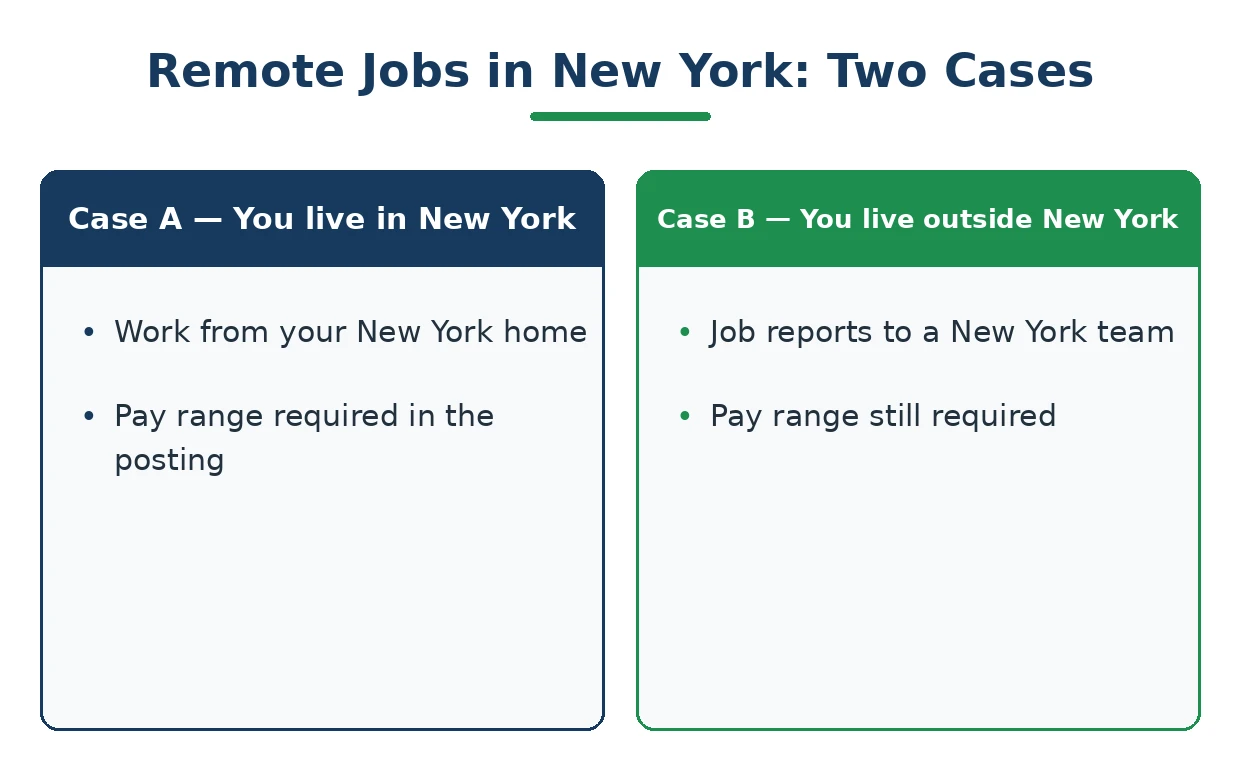
One search phrase, two different job hunts
Case A: you live in New York and work remotely from there. The job is performed, at least in part, inside the state, even if your office is a kitchen table in Rochester.
Case B: you live outside New York, and the job is performed outside the state too, but it reports to a supervisor, an office, or another work site in New York. This is the clause many remote job hunters miss. Under the state law, that reporting line is enough: the posting still has to carry a pay range, even if you never set foot in the state.
Two edges are worth knowing. First, an occasional trip into New York for a meeting or conference does not, by itself, pull a job under the state law; the Department says infrequent visits are not enough to count as a job performed in the state. Second, the reporting line has to be real: if your direct supervisor works from a home in New York, but the company and its leadership are based in another state and the job can be done from anywhere, the posting is not required to show a range under the state law.
Why New York postings show a pay range
New York has two transparency laws, and a single posting can be covered by both.
The state law, the Pay Transparency Act, took effect on September 17, 2023. The Department of Labor’s FAQ on the Pay Transparency Act states the rule plainly: postings for jobs performed, at least in part, in New York must include a range of pay, and so must postings for jobs performed outside the state that report to a supervisor, office, or other work site in New York. The law reaches advertisements however they are published, including postings placed by recruiters or job boards for an employer.
New York City’s law came first. It took effect on November 1, 2022, and is enforced by the city’s Commission on Human Rights. Its fact sheet, Salary Transparency in Job Advertisements, says employers with four or more employees (owners count toward the four), or one or more domestic workers, are covered as long as at least one employee works in New York City.
| Law | In effect since | When a posting must show a range | What the range is |
|---|---|---|---|
| New York State Pay Transparency Act | September 17, 2023 | The job will be performed at least in part in New York State, or it is performed outside the state but reports to a supervisor, office, or work site in New York | The minimum and maximum pay the employer believes in good faith it will pay; a job description must appear too, where one exists |
| New York City salary transparency law | November 1, 2022 | A covered employer (four or more employees, at least one in NYC) advertises a job that can be performed in whole or in part in New York City, including remotely | A good-faith minimum and maximum base pay; it cannot be left open-ended |
How to read the range in a New York posting
A range is information, not a guarantee. Read it with these points in mind.
Start with “good faith,” because the Department defines it. The range should be the pay the employer honestly believes, at the time of posting, that it is willing to pay the person it hires. Posting a range above what you are willing to pay is not good faith. A range can still be revised during hiring, and an offer can land above the posted top for a candidate whose qualifications exceed what the range was built on.
Watch out for the very wide range. When a span is so broad that you cannot tell what the job really pays, the Department does not count it as good faith, and the employer has to be able to explain why it is that wide. So ask, early on: where would someone with my experience land?
One more boundary: the range covers base pay and nothing else. Under the city guidance, the stated salary is the base wage or rate of pay. Health insurance, paid time off, retirement contributions, severance, overtime, commissions, tips, bonuses and stock all sit outside it. Compare base to base, then look at the extras, which employers may list separately.
“$20 an hour and up” is the one shape you should never see: neither law allows an open-ended range. A single fixed rate is fine. A posting may show one figure, such as “$20 per hour,” with minimum and maximum the same.
Finally, check that the range in front of you is the one meant for you. The Department requires the range to fit a single opportunity in a single geographic region. A posting covering several locations or levels should show a separate range for each. If you see two ranges on one posting, find the one attached to your location or level before you judge the pay.
What common remote roles pay in New York
We name role types here, not companies. Remote postings open and close quickly, and a company name printed in a guide can point you at a filled job within weeks. Check each employer’s own careers page for live openings, and judge posted ranges against the figures below.
These are New York State figures from the Bureau of Labor Statistics’ 2025 wage data, published through O*NET’s state wage pages (customer service figures). They cover each occupation across the whole state; they are not remote-only salaries.
| Role type you will see in remote postings | New York median pay | New York lowest-paid 10% |
|---|---|---|
| Customer service representative | $48,000 a year ($23.08 an hour) | $36,270 a year or less ($17.44 an hour) |
| Data entry keyer | $44,860 a year ($21.57 an hour) | $34,130 a year or less ($16.41 an hour) |
| Secretary or administrative assistant | $49,600 a year ($23.85 an hour) | $37,330 a year or less ($17.95 an hour) |
Read the medians honestly. A median is the middle of the whole occupation: half of New York’s customer service representatives earn more than $48,000 and half earn less, across every experience level and setting. It is not a starting salary. Beginners should plan around the lower band: one in ten workers in these occupations earns the “lowest 10%” figure or less, and first offers often land near there. That is the same pattern our guide to entry level remote jobs is built on: beginner roles pay beginner money first, and the starting band sits well below the median. The secretary and administrative assistant row is the reference point for most remote administrative postings, since those jobs sit inside that occupation in the federal data.
The floor under New York pay: the 2026 minimum wage
Medians describe the middle. The legal floor is simpler. The Department of Labor’s minimum wage history page shows that from January 1, 2026, the general minimum wage is $16.00 an hour across most of New York State, and $17.00 an hour in New York City, Long Island, and Westchester County.
If you work from a New York home as an employee, an hourly posting priced below the floor for your location is a serious warning sign. A posting at exactly the floor is legal, but the role is priced at the bottom of the market.
How to search and apply: a step-by-step pass
- Settle your case first. Decide whether you are Case A (living in New York) or Case B (living elsewhere, reporting into New York), and set your job-board location filter to match.
- Read the location line before the duties. Many remote postings limit hiring to named states, or ask for overlap with Eastern Time hours. A posting that excludes your state will not bend for a strong application.
- Next, match the range to your region. If the posting shows more than one range, use the one for your location. If it shows one range and you are in Case B, plan to confirm which range applies to you.
- Use the pay table above as a sanity check. A support range that tops out far below the state median is not automatically a bad job, but it is a reason to ask what the role really involves.
- Do not stop at the title; read the job description. The state law expects a description in the advertisement where one exists. A posting with a wide range and no real duties gives you nothing to prepare for.
- Tailor your resume to the posting’s own words. Match the skills the employer names, with honest examples behind each one. Our resume skills guide shows how to choose and present those skills.
- Apply on the employer’s own site where you can, and ask the location question early: “Is this role hired in my state, and which posted range applies to my location?” One sentence now prevents a wasted interview process.
Two cautions before you count on New York pay
First, a New York range is not a promise of New York pay for a worker somewhere else. Employers who hire across states commonly set pay by the worker’s location, and the state law itself expects a range per region. The range you saw may belong to the New York version of the job. Case B readers: confirm your range in writing before you resign from anything.
Second, know whether the offer is employment or contract work. The transparency rules and the wage floor above are built around employees. Some remote support work is offered to independent contractors instead: self-employment, with different tax handling, no employee benefits, and more of the risk sitting with you. Neither route is automatically wrong, but they are different deals, and a posting should say which one is on offer. If the duties sound like a job and the paperwork says contractor, ask before you sign.
One scam rule worth memorizing
Keep one rule from the Federal Trade Commission’s job scams guidance in mind: honest employers will never ask you to pay to get a job. Anyone who asks for money for training, equipment, or a starter kit before you are hired is running a scam. Legitimate training runs the other way: the employer pays for it, as the postings in our guide to remote jobs with paid training show. The same goes for a “paycheck” you are told to deposit and partly send on; that check will bounce. This rule covers employment. Contractor platforms are a separate arrangement, with their own published terms; a fee you can read in advance is a different thing from a stranger demanding payment over chat.
New to remote work altogether?
This guide assumes you know the beginner basics: the roles that hire without experience. If you do not, start with our guide to work from home jobs with no experience, then come back here for the New York layer.
Frequently asked questions
Does New York’s pay transparency law cover remote jobs?
Yes, in the two situations this guide is built on. A remote job performed at least in part in New York State must be advertised with a pay range, and so must a job performed outside the state that reports to a supervisor, office, or work site in New York. The city law separately covers jobs that can be performed in New York City, including remotely, when the employer meets the city’s size threshold.
I live outside New York. Will postings for New York teams still show me a range?
Often, yes. Under the state law, if the job reports to a supervisor, office, or other work site in New York, the advertisement must include a range even though you would work from another state. An occasional trip into New York for a meeting does not trigger the requirement on its own, and neither does a supervisor who happens to work from a New York home for a company led from another state.
Do all New York job postings have to show pay?
No. The state law governs advertisements for covered jobs; it does not force an employer to advertise an opening at all, and it does not hold employers responsible for copies of their postings that third-party sites scrape and repost without consent. The city law has its own coverage line, set out above. A posting without a range is not automatically a scam, but it is worth a question.
Is a very wide pay range a warning sign?
It is a reason to ask questions, not a reason to walk away on its own. The Department of Labor says a range so broad that applicants cannot understand the real pay is not posted in good faith, and a wide range needs an explanation. Wide ranges often bundle several seniority levels or locations; ask which part fits you.
What is New York’s minimum wage in 2026?
From January 1, 2026, the general minimum wage is $16.00 an hour in most of New York State and $17.00 an hour in New York City, Long Island, and Westchester County, according to the New York State Department of Labor. The Department states that the same rates remain in place on January 1, 2027. Some industries have their own wage orders, so treat these as the general floor.
Does the posted range include bonuses, benefits, or overtime?
No. Under the city guidance, the range states base pay only: the base annual salary or hourly wage. Health insurance, paid time off, retirement contributions, severance, overtime, commissions, tips, bonuses, and stock sit outside the range, though an employer may describe them separately. Price the rest of the package on its own.
Conclusion
“Remote jobs in New York” is really two searches. If you live in the state, most advertised postings show you a good-faith range and a job description before you apply. If you live elsewhere and report to a New York team, the law puts a range in front of you, but confirm the range you read is the one attached to your location. Judge any range against the state figures, ask early, and never pay anyone for the chance to work.
When you are ready to look at real openings, start with the current listings on our jobs page and hold each posting’s range up against the state figures in the table above.
How we check our numbers. Every legal detail here was read on the Department of Labor’s Pay Transparency Act FAQ, its minimum wage pages, or the City Commission on Human Rights fact sheet, on October 24, 2026. Every pay figure comes from the Bureau of Labor Statistics’ 2025 wage data as published on O*NET’s New York wage pages, checked the same day. We name no employers, because we did not verify any company’s live New York remote openings today.
Sources
– New York State Department of Labor, Pay Transparency Act FAQ
– NYC Commission on Human Rights, Salary Transparency in Job Advertisements (fact sheet)
– New York State Department of Labor, History of the Minimum Wage in New York State
– New York State Department of Labor, Minimum Wage
– O*NET OnLine, New York Wages, Customer Service Representatives (BLS 2025 wage data)
– O*NET OnLine, New York Wages, Data Entry Keyers (BLS 2025 wage data)
– O*NET OnLine, New York Wages, Secretaries and Administrative Assistants (BLS 2025 wage data)
– Federal Trade Commission, Job Scams
About the author: Tajammul Abbasi researches and compiles U.S. job-market data from the Bureau of Labor Statistics and O*NET for HirePath USA, focusing on entry-level and remote roles. Every pay figure in this guide comes from the U.S. Bureau of Labor Statistics or the New York State Department of Labor, checked at the source; no employer wages are quoted, because no individual employer’s openings were verified for this guide. Last reviewed: October 24, 2026.