
The short answer: Warehouse jobs pay a national median of $38,220 a year ($18.38 an hour) for hand laborers and material movers, according to the Bureau of Labor Statistics (May 2025). Most entry-level warehouse roles require no experience and no formal education, and training typically takes a month or less on the job.
In this article
- What are warehouse jobs?
- What are the main types of warehouse jobs?
- How much do warehouse jobs pay?
- Can you get a warehouse job with no experience?
- What do you need to work in a warehouse?
- What shifts do warehouse jobs offer?
- Which big employers hire warehouse workers?
- How do you find warehouse jobs near you?
- How to apply for a warehouse job, step by step
- How can you earn more? The forklift path
- How do you spot a warehouse job scam?
- Frequently asked questions
- The bottom line
What Are Warehouse Jobs?
Warehouse jobs are hands-on roles in the buildings where goods are received, stored, picked, packed, and shipped — distribution centers, fulfillment centers, and shipping hubs. They are one of the most open doors in the U.S. job market if you have no degree and a short work history: the Bureau of Labor Statistics (BLS) counts about 6.9 million hand laborer and material mover jobs in 2025 and projects roughly 904,200 openings a year through 2035, most from workers moving on or retiring.
Two honest caveats. First, this is physical work — standing, walking, and lifting through most of a shift. Second, the pay figures here are national medians across all experience levels, not starting wages; beginners usually start below them. Switching fields? Our guide to the best jobs for career changers compares other fresh-start options.
What Are the Main Types of Warehouse Jobs?
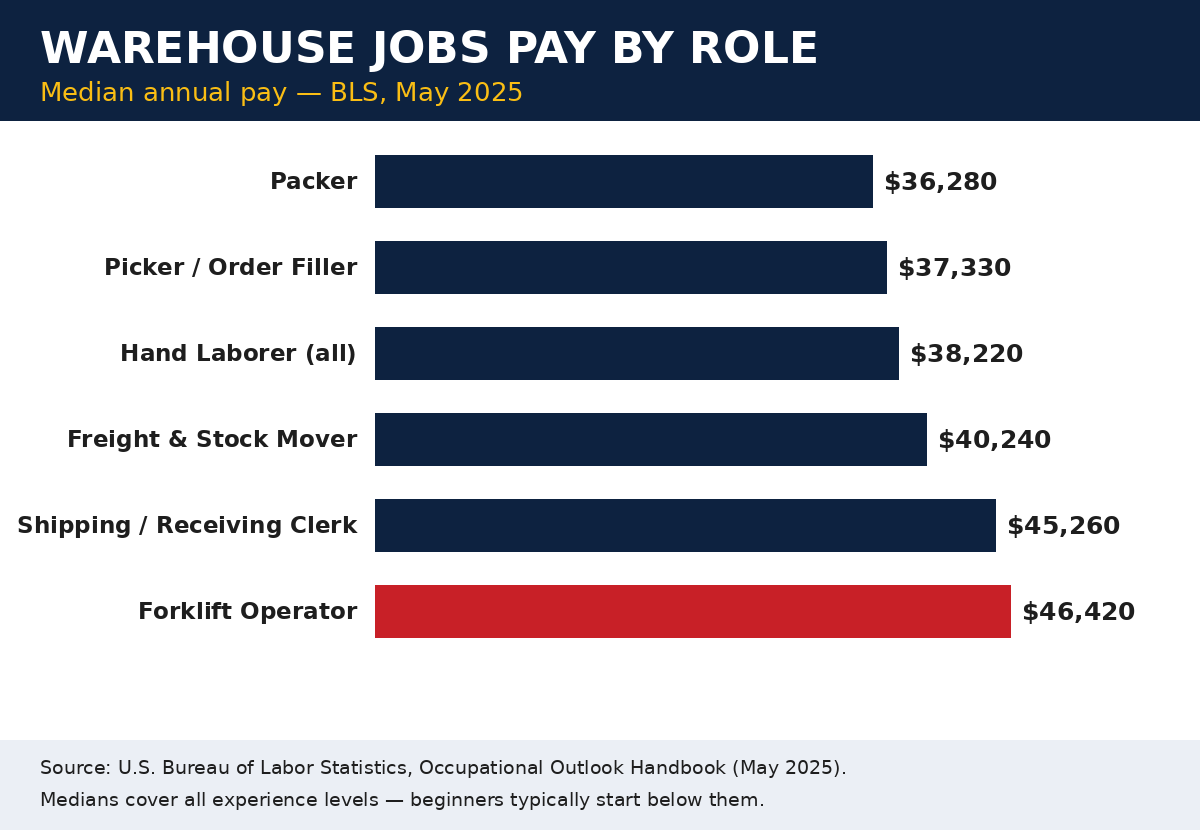
The main types are warehouse worker (material handler), picker, packer, package handler, forklift operator, and shipping/receiving clerk. A warehouse associate is a general warehouse worker who may rotate through several of these tasks in one shift:
| Role | What you do | Median pay (BLS, May 2025) | Typical entry needs |
|---|---|---|---|
| Warehouse worker / material handler | Move freight and stock by hand; load and unload trucks | $40,240/yr (laborers and freight, stock, and material movers, hand) | No formal credential; no experience |
| Picker / order filler | Collect items from shelves to fill orders, often with a scanner | $37,330/yr (stockers and order fillers) | No formal credential; no experience |
| Packer | Pack, label, and inspect products for shipment | $36,280/yr (packers and packagers, hand) | No formal credential; no experience |
| Package handler | Load, unload, scan, and sort packages at shipping-company hubs | No separate BLS figure — duties sit in the material handler family above | No experience, per UPS and FedEx postings below |
| Forklift operator | Move pallets and heavy stock with powered industrial trucks | $46,420/yr (industrial truck and tractor operators) | Employer training and certification |
| Shipping, receiving & inventory clerk | Record incoming and outgoing shipments; track inventory | $45,260/yr | High school diploma typical |
Warehouse Worker / Material Handler
The generalist role: you move materials between storage areas, docks, and trucks, often tracking packages with a handheld scanner. BLS median: $40,240.
Picker / Order Filler
A picker is a worker who retrieves products from storage to complete customer or store orders. BLS covers the role as stockers and order fillers ($37,330 median) and expects it to keep growing with online ordering.
Packer
A packer is a worker who packages products by hand, labels cartons, and checks items for defects before they ship. At a $36,280 median — the lowest here — packing is best treated as a first rung.
Package Handler
A package handler is a worker at a parcel company hub who loads, unloads, scans, and sorts packages so they reach the right truck or plane. The title belongs mainly to UPS and FedEx; BLS does not track it separately, so use the material handler figures as your pay guide and check any posting’s rate.
Forklift Operator
A forklift operator is a worker who drives powered industrial trucks to lift and move pallets and heavy stock. At a $46,420 median it is the highest-paid role here — and you do not need to arrive with a license in hand (see the earning-more section).
Shipping, Receiving & Inventory Clerk
The records side of the warehouse: checking shipments in and out, scanning barcodes, keeping inventory accurate. The least physical role here, and the one that typically asks for a high school diploma; median $45,260.
How Much Do Warehouse Jobs Pay?
For the broad warehouse workforce — hand laborers and material movers — the BLS median was $38,220 a year, or $18.38 an hour, in May 2025. Read that the way BLS means it: a median is the middle of all earners, from first-month hires to veterans, across the whole country. It is not a starting wage, and the occupation also covers manufacturing, wholesale, and retail settings. Beginners typically start below it and work toward it.
Where you work moves the figure: within the same group, workers in the transportation and warehousing industry itself had a median of $44,710. Shift matters too — overnight and weekend work often carries a premium, but each employer sets its own amount, so no honest guide can quote a standard rate. One official example: a Walmart freight handler posting lists premiums of $0.35 to $3.00 an hour that “may be based on schedule, facility, season, or specific work performed.” Peak-season overtime can also raise take-home pay without changing your base rate.
Run your own numbers with the estimator below, using the rate from an actual posting or offer.
Warehouse Pay Estimator
Estimated weekly gross:
Estimated monthly gross:
Estimated annual gross:
Enter the rate from your own job offer — this tool does not fetch pay data. Estimates are gross pay before taxes and do not include overtime premiums.
Can You Get a Warehouse Job With No Experience?
Yes — for the core floor roles, no experience is the normal starting point. BLS lists no work experience and no formal educational credential for hand laborers and material movers, with on-the-job training of a month or less. Postings agree: FedEx's Handler posting lists minimum experience as "None," UPS seasonal postings state "no experience necessary," and Walmart's freight handler posting lists no minimum qualifications at all.
Hiring runs through two routes. Direct hiring: you apply on the employer's own careers site, complete any assessment, and pass pre-hire checks before orientation. Staffing agencies: agencies recruit for warehouses that need people quickly, especially in the autumn peak; seasonal roles are a common way in. With an agency, your employer of record may be the agency rather than the warehouse, so check who hires you, who pays you, and whether the role is temp, temp-to-hire, or direct. Either way, honest employers and agencies do not charge you to get hired.
What do screeners look for instead? Reliability, the physical ability the role requires, and shift availability — a candidate who can start soon and cover an unpopular shift often beats an experienced one who cannot.
What Do You Need to Work in a Warehouse?
For most floor roles the list is short and includes no college degree — BLS lists no formal educational credential for hand laborers and material movers, making warehouse work one of the larger groups of jobs that don't require a college degree. Clerk roles are the exception; a high school diploma is typical there.
- Work authorization. You must be legally authorized to work in the United States; UPS postings state this outright, and employers verify eligibility at hiring.
- Physical ability, honestly assessed. FedEx handlers lift 50 lbs without assistance, UPS package handlers up to 70 lbs, Target warehouse workers 35–50 lbs frequently and up to 60 lbs occasionally. If a posting's numbers are beyond you, believe them and consider the clerk roles.
- Sturdy work shoes. UPS's seasonal postings list sturdy work boots or slip-resistant shoes among what you will need.
- Shift availability. Wider availability for early, late, overnight, and weekend sorts means more postings you qualify for.
- Basic reading, counting, and scanner use. Target's posting asks for accurate basic math and reading labels and tickets; handheld devices are used after training.
What Shifts Do Warehouse Jobs Offer?
Because freight moves around the clock, warehouse jobs come in more shift shapes than most industries. BLS notes most hand laborers and material movers work full time, although part-time work is common and schedules may include nights and weekends.
- Full-time — the standard pattern at distribution and fulfillment centers, and the usual route to benefits eligibility.
- Part-time warehouse jobs — common at parcel hubs, where sorts run a few hours at a time (UPS postings often describe roughly 3–5 hours a day) — a fit for students or anyone pairing warehouse work with other duties.
- Overnight warehouse jobs — night sorts are where employers most often add a shift premium (see the pay section).
- Weekend shifts — some facilities run compressed weekend patterns; Walmart's posting lists weekday day, evening/overnight, and weekend schedules side by side.
- Seasonal warehouse jobs — hiring surges in the autumn peak, and roles have a set end date: UPS says continued employment beyond the season is not guaranteed, though many team members start seasonal and later pursue other roles there.
Which Big Employers Hire Warehouse Workers?
Major warehouse employers hire through their own official sites — start there, not with recruiters who contact you first. What each company's own pages say, checked in November 2026:
- Amazon — its hourly hiring site carries the headline "Skip the interview" and states: "Apply quickly, with no resume or interview required," describing warehouse roles as prepping, sorting, and loading packages.
- Walmart — freight handlers unload, order-fill, pack, and load freight. In the posting we checked, the minimum qualifications section lists none at all, under Walmart's own note: "If none are listed, there are no minimum qualifications."
- UPS — warehouse workers (package handlers) load and unload trailers and package cars and sort packages. Its seasonal postings state "no experience necessary," listing lifting up to 70 lbs and U.S. work authorization as what you will need.
- FedEx — its Handler (warehouse-like) posting lists minimum education: None, and minimum experience: None; the physical bar is lifting 50 lbs without assistance, with equipment or help for heavier packages.
- Target — its warehouse postings list physical requirements and being trainable on powered equipment, including forklifts, rather than any prior-experience requirement; Target provides training for all equipment, and its application adds a questionnaire and assessment.
None of this means an opening exists near you today — postings open and close constantly. Check your area on the official sites, and treat any "recruiter" asking for money or personal details by text as a warning sign.
How Do You Find Warehouse Jobs Near You?
Start with the employers' own sites, searching by ZIP code — postings there are most current and applications are free. Then widen out: job boards let you filter "warehouse jobs near me" by distance, and local staffing agencies often know about openings that never reach a board. You can also browse the listings on HirePath's find jobs page.
Apply two filters first. The commute: a slightly higher rate disappears if the site is an hour away and your shift starts before buses run. And the shift pattern: apply only to patterns you can genuinely cover, because availability is a main thing screeners test.
How to Apply for a Warehouse Job, Step by Step
Warehouse applications are usually shorter than office-job applications, and some employers skip parts of the traditional process entirely. If you do need a resume, our skills to put on a resume guide helps you present reliability, physical work, and any scanning, stocking, or team-based experience. Then:
- Pick your target: role and shift. Choose the role that fits you and the shift patterns you can actually work; applications matching a posting's schedule needs move fastest.
- Apply on the employer's own site. Use the official links above. Some processes are light — Amazon's hourly site says no resume or interview is required — while Target's adds a questionnaire and assessment. Complete the official process, on the official site only.
- Keep your phone on and answer. Screeners often call or text soon after you apply; missing the first call can cost you the slot. If a "recruiter" instead asks you to pay a fee or deposit a check, that is the scam pattern below.
- Attend the pre-hire appointment with your documents. Bring the identification and work-authorization documents the employer asks for.
- Complete orientation and safety training. BLS puts typical on-the-job training for these roles at a month or less, and forklift hopefuls get equipment training through the employer (next section).
One boundary: delivery driving is a different path, with its own licensing and vehicle requirements, so this guide does not cover it — and any "warehouse" offer that turns out to be reshipping packages from home is a scam, not a delivery job.
How Can You Earn More? The Forklift Path and Moving Up
The clearest pay lever inside the warehouse is equipment. Industrial truck and tractor operators — forklift operators — had a median of $46,420 a year in May 2025, versus $38,220 for the hand laborer group; machine operators in the warehousing and storage industry itself had a median of $48,170.
You generally do not buy your own forklift course to get started. Describing how these operators are trained, BLS notes that forklifts "may take only a few days to learn how to operate," that new workers are usually trained by an experienced employee, and that employers must certify that each operator has received the proper training under Occupational Safety and Health Administration (OSHA) rules. The common route: get hired into a floor role, prove reliable, and ask about equipment training — Target's posting says the same from the employer side.
Beyond equipment, clerk roles ($45,260 median) reward accuracy and computer comfort, and experienced floor workers move into lead and trainer roles — FedEx posts a Package Handler Trainer role preferring six months of handler experience. We quote no supervisor salary here, because we have not verified one against an official source; the verified ladder is floor role → equipment or clerk role.
How Do You Spot a Warehouse Job Scam?
Fast, high-volume hiring attracts fake recruiters, so run every offer through the Federal Trade Commission's tests. The FTC's core rule: honest employers will never ask you to pay to get a job. The patterns:
- You are asked to pay to get hired — for "training," a starter kit, a certification, or equipment. Per the FTC, that is a scam; real forklift certification is arranged by the employer, as described above.
- A placement service or "recruiter" wants a fee from you. The FTC: honest placement firms are typically paid by the hiring company, not by candidates — a firm that charges you, especially in advance, is one to walk away from.
- A check arrives, with instructions to send part of the money on. That is the fake check scam: the check bounces, the bank holds you responsible, and the scammer keeps your money.
- The "job" is receiving and reshipping packages at home. The FTC is explicit: reshipping is never a real job — the goods are typically bought with stolen cards.
- The whole process happens over text messages. Target's own careers page warns it will never ask for personal information via text message for a position; treat a text-only process from an unverifiable sender as a warning sign.
Before accepting anything, search the company name plus "scam" or "complaint," and apply only through official sites like those linked here. FTC guidance: consumer.ftc.gov/articles/job-scams; report scams at ReportFraud.ftc.gov.
Frequently Asked Questions
Do warehouse jobs require experience?
No, not for entry-level floor roles. BLS lists no work experience for hand laborers and material movers; FedEx's Handler posting lists minimum experience as "None," and UPS seasonal postings state "no experience necessary."
How much do warehouse jobs pay per hour?
The BLS median for hand laborers and material movers was $18.38 an hour ($38,220 a year) in May 2025. It covers all experience levels nationwide, so beginners typically start below it; forklift operators sit higher, at a $46,420 annual median.
Do you need a diploma for a warehouse job?
For floor roles, BLS lists no formal educational credential, and the employer postings above list no education requirement either. Shipping, receiving, and inventory clerk roles are the exception — a high school diploma is typical there.
Are night shifts paid more?
Often, but there is no standard rate: each employer sets its own premium — one Walmart posting lists schedule-based premiums of $0.35 to $3.00 an hour. Check your posting, and use the estimator above with your differential to see what it adds up to.
How do I get forklift certified?
Usually through your employer. BLS notes forklift operation takes a few days to learn, training happens on the job, and employers must certify each operator's training under OSHA rules. The standard route is a floor role first, then equipment training.
Are warehouse jobs full-time or part-time?
Both exist. BLS notes most hand laborers and material movers work full time, although part-time work is common and schedules may include nights and weekends; parcel hubs post shorter part-time sorts, and seasonal roles have a set end date.
The Bottom Line
Warehouse jobs are one of the few large doors into work that ask for reliability and physical effort instead of credentials: about 6.9 million jobs, roughly 904,200 openings a year, no formal education requirement for the core roles, training measured in weeks. Go in with accurate expectations — the work is physical, and medians are not starting pay. When you are ready, browse current openings on HirePath's find jobs page and apply through the employer's official site.
Sources
- U.S. Bureau of Labor Statistics, Occupational Outlook Handbook — Hand Laborers and Material Movers · Material Moving Machine Operators · Material Recording Clerks (May 2025 data)
- Federal Trade Commission — Job Scams
- Employer pages checked November 2026 — Amazon hourly hiring · Walmart Freight Handler posting · UPS Jobs · FedEx Handler posting · Target Warehouse Operations posting
About the author: Tajammul Abbasi researches and compiles U.S. job-market data from the Bureau of Labor Statistics and O*NET for HirePath USA, focusing on entry-level and no-degree roles. Every national pay figure in this guide comes from the U.S. Bureau of Labor Statistics; the employer details quoted are from the companies' own careers pages. Last reviewed: November 4, 2026.